Three of the twelve actual participants refuse to perlong with the experiment because they thought it was very scary, stressful and inhuman to be perform such cruel act on a human being after the
actor started to bang on the wall that separated him from the subject. After
several times banging on the wall and complaining about his heart condition, all responses by
the learner would stop.
Whenever the teacher indicated his desire to halt the experiment,
he was given a succession of verbal prods by the experimenter, in this order:
1. Please continue.
2. The experiment requires that you continue.
3. It is absolutely essential that you continue.
4. You have no other choice, you must go
on.
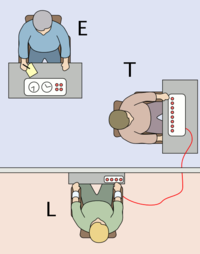
The
experimenter (E) orders the teacher (T); the subject of the experiment, to give
what the subject (teacher) believes are painful electric shocks to a learner (L), who is
actually an actor and confederate. The subject believes that for each wrong answer,
the learner was receiving actual electric shocks, however in reality there were
no such punishments. Being separated from the subject, the confederate set up a
tape recorder joined with the electro-shock generator, which played
pre-recorded sounds for each shock level.
What I have concluded from both "The Five Faces of Oppression" and "The Milgram Experiment" is that they are both based on the
matter of POWER, OBEDIENCE, DEVIANCE AND ORDER. We are
obedient in following instruction from people in authority in any institution
such as the family, school, church, government etc. and as bear consequences in any group, people tend to use social mechanism such as ridicule, gossip, opprobrium as a mean of punishment for violating the social norms, rather than using physical violence which is the oldest method that have been used for decades to restore formality
I remember growing up, my mother being the breadwinner of the household and a single-parent, I had to obey her every rules, and if I am disobedient she would use ridicule as a mean of causing embarrassment to me. Like one night i was down the street with my friends chit chatting and the lights went out, and even though i knew i should have make an attempt to find my way home to avoid any potential threat, i insist on staying to chat with them, little after I felt someone grab me from behind and start hitting me, when turn around it was my mother saying "likkle gal yuh nuh see light gone and you pon di road like you a boy pickney and man can tek yuh wey and rape yuh. Go inna di yaad before me embarrass you out yah!" Little she knew I was already feeling that way because my friends were all laughing at me and for days I refused to see them. But, now I understand the true meaning of what mom was try to tell me. Now I realize the importance of social control, because if she had not put her feet down firmly on the ground and raise me in the right way I might have ended up elsewhere.
I remember growing up, my mother being the breadwinner of the household and a single-parent, I had to obey her every rules, and if I am disobedient she would use ridicule as a mean of causing embarrassment to me. Like one night i was down the street with my friends chit chatting and the lights went out, and even though i knew i should have make an attempt to find my way home to avoid any potential threat, i insist on staying to chat with them, little after I felt someone grab me from behind and start hitting me, when turn around it was my mother saying "likkle gal yuh nuh see light gone and you pon di road like you a boy pickney and man can tek yuh wey and rape yuh. Go inna di yaad before me embarrass you out yah!" Little she knew I was already feeling that way because my friends were all laughing at me and for days I refused to see them. But, now I understand the true meaning of what mom was try to tell me. Now I realize the importance of social control, because if she had not put her feet down firmly on the ground and raise me in the right way I might have ended up elsewhere.

It's amazing how power is all around us and determines our future. I liked how you summarized the reading and video into power, obedience deviance and order. Those words really explain what was happening in the video where the people were just listening to the authority figure instead of what they were thinking. And I love the example of your mother bringing your from outside the house and telling you to get home, she established power over you and you had to follow her rules even if you didn't want to. Great post!
ReplyDeleteThank you Rebekah!
ReplyDeleteOkay you had me dying with the last part about your mother LOL (literally). But I totally understand. If you never put that fear or discipline into your child then they wouldn't know what obedience is. In that case obedience lead to your safety but in the case of the Milgram experiment obedience could have lead to danger. Having power over someones actions can be for the better or for the worse. Power is powerful!
ReplyDeleteLol @ Justin am glad you see my point.
ReplyDeleteI really like how you explain and connect the article with the experiment. It is true how people are used to follow rules from authorities, such as people that have power. We follow that so we don't destroy our social structure because we think that if we do something wrong it might affect our society.
ReplyDeleteAlso your example was very good, my mom has done that to my sister and i remember laughing at her for days too lol
Thank you Carla :)
ReplyDeleteI like how you worked in your personal experiences with the article and video. On a honest note, I was raised the same way with the twist. Whenever I was disobedient I would get handled by my mother and then have to deal with my father whenever he reached home. I've had plenty of sleepless nights pertaining to my acts in school. The power was more verbal and threats but later on and now I'm realizing how much it helped me.
ReplyDeletethank you Denzel and i guess many more can relate to our experience.
ReplyDeleteI enjoyed your post and I like how you visualized it by adding the picture your post is very interest and true
ReplyDeleteThank you Mutiat
DeleteI really this post because you explain the article with the experiment. It is about how people are used to follow rules n orders from supreme people in power or ahead of them
ReplyDeleteThank you
ReplyDelete